
The event kicked off with an opening presentation, during which the organizers introduced the organizing team, the partners, and finally outlined how the Grand Final would unfold. We spent the rest of the evening testing the equipment and networking, while the teams’ personal impressions of the competition added to the atmosphere of Friday night. For example, the Brno-based Kapibary team, participating for the third time, views the competition as a great opportunity for aspiring IT students to experience working under pressure and communicating with clients. In contrast, the newcomers from the Weboví slabikáři team particularly appreciated the chance to learn something new.
Saturday began with Vítězslav Kříž, representing the fictional client Think different Academy, presenting a broad challenge for the Grand Final. Unlike in previous years, the application was not developed based on a specific brief; the Think different Academy client team was divided into project managers, methodologists, instructors, and finance managers, each with their own requirements. The contestants were tasked with determining which requirements were worth implementing so that the app would be functional, could be completed on time, and would satisfy most—or ideally all—departments of the client team.
Programming began at nine in the morning. However, most of the contestants headed to the room with the clients to find out exactly what features they were supposed to build. Once they had spoken with all the members of the client team, they rushed back to their computers and started programming. Around lunchtime, when nearly half of the time allotted for programming had already passed, signs of fatigue were beginning to show in the teams. For example, the Velká Hora team admitted that it wasn’t entirely without its challenges, but they were gradually making progress and managing to work together. The Fabinka Bábinka team evaluated their work very positively; they described the collaboration as excellent and functioning without major difficulties, even though it wasn’t entirely easy at first to get a handle on the client’s requirements.
After a long nine hours, the programming session ended. Here, another change from last year emerged; the competing teams were divided into four groups, each consisting of four people from both the client and mentor teams. The teams presented their application to these groups in six to seven minutes, focusing on how it works and which client requirements they had implemented, followed by questions from the jury. Once everyone had presented and enjoyed a good meal, the jury retired to decide which top 5 teams would compete for the top spots. Four teams emerged from the top of each group, but the fifth had to be selected by the judges as a wild card from among the four teams in second place, which was no easy task.
On Sunday, the teams gathered with bated breath in the lecture hall to hear who would advance to the next round. Before the preliminary results were announced, the competition coordinator, Vojtěch Zima, gave a speech in which he inspired the contestants and commended all the teams for making it to the Grand Final. Afterward, Vítězslav Kříž spoke briefly about his experience with Tour de App, specifically about shaping Tour de App into what it looks like today. After this speech, there was no point in keeping everyone in suspense any longer. The teams AMD16, Bobr Layer, Co je to API?, Error Makers, and nejkulaťoulinkovatější míčovina advanced to the next round.
After the announcement, you could sense that some of the tension had eased. And since these five teams were tasked with presenting their app to a panel of investors, Lukáš Bravanský followed the announcement with a workshop on how to deliver a proper pitch. The advancing teams then headed off to prepare their pitches. Meanwhile, Jakub Fiala from Gordic spoke to the remaining teams about a modern approach to development in the age of artificial intelligence. Lukáš Bravanský once again closed the program for the non-advancing teams, expanding on his previous presentation by demonstrating how to present effectively, including the use of facial expressions, tone, and volume.
Once all five top teams were ready, they presented to the expert panel. The panel consisted of Lenka Hetflajšová, Petra Vojáčková, Martin May, Tomáš Kebrle, and Vojtěch Zima. The first team to present was "Co je to api?". They quickly outlined the features of their solution and how it increases efficiency by an impressive 12,000 percent. Next up was the AMD16 team. Their priority was to make teachers’ work as easy as possible and to ensure students didn’t get bored during class. In addition, they didn’t overlook potential expansion of Think different Academy; the app allowed for adding more branches and managing content separately for each one. The team Error Makers addressed the issue of boredom in class; among other things, they implemented their own currency, which students can earn by completing quizzes and challenges and then use in the store.
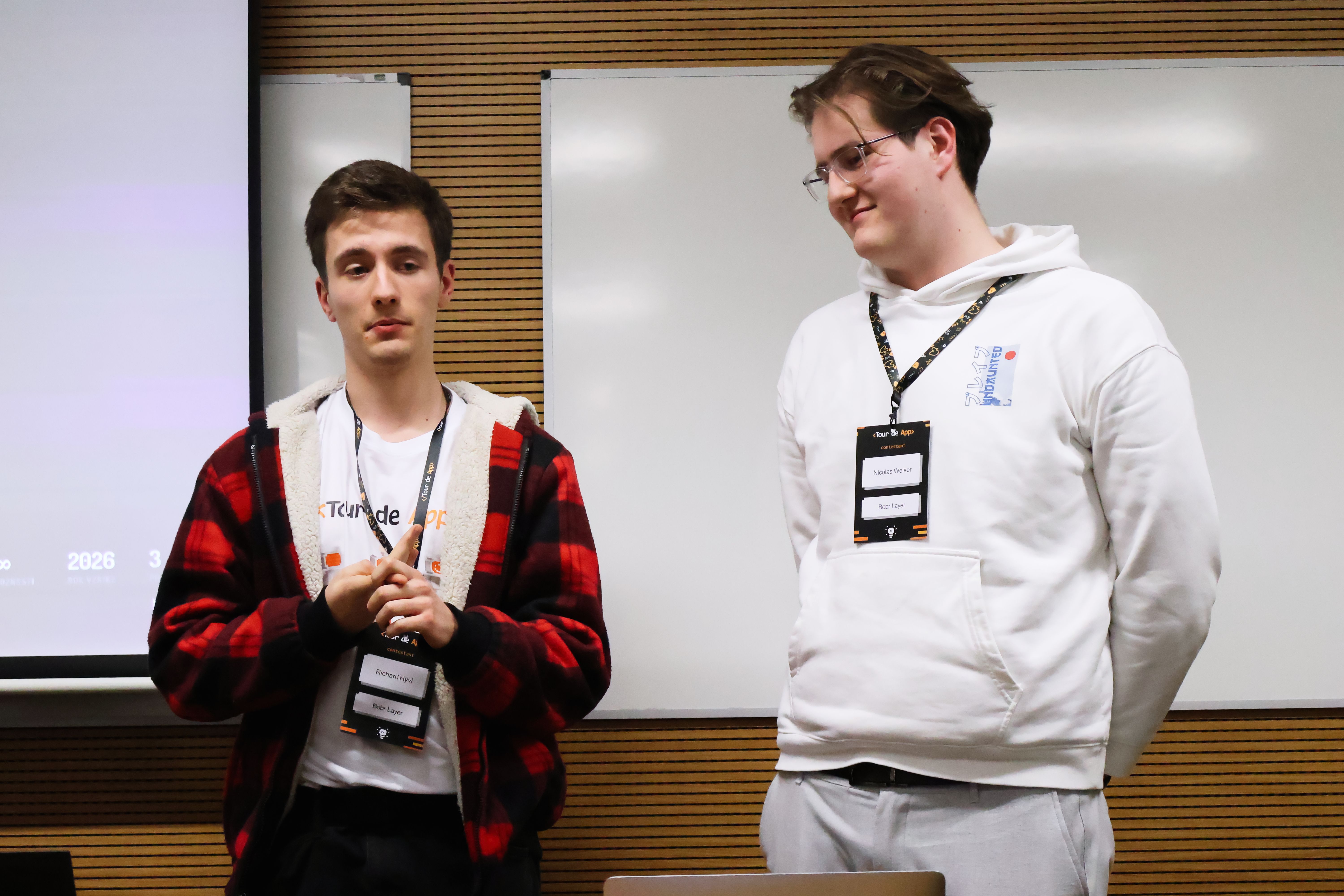
Have you ever had to train someone new on your team? You’ve surely thought about how exhausting it is, and that’s exactly why the app from the team “nejkulaťoulinkovatější míčovina” was there—ready for global deployment. The final team, Bobr Layer, focused primarily on the app’s clarity and gamification elements to motivate students to keep learning. They based their revenue model on offering the app to companies and schools so that students themselves wouldn’t have to pay anything and wouldn’t be bothered by ads.
Right after their presentations, the teams went to have their photos taken and grab a hearty meal. Once everyone had eaten, they gathered in the lecture hall and waited anxiously for the jury to arrive, who had been deliberating on the finalists’ rankings in the meantime. After a long wait, the Bobr Layer team was crowned the overall winner of Tour de App 2026—a two-person team that had been selected for the top 5 as a wild card and hadn’t originally entered the competition with the goal of winning, but ultimately took home the victory.